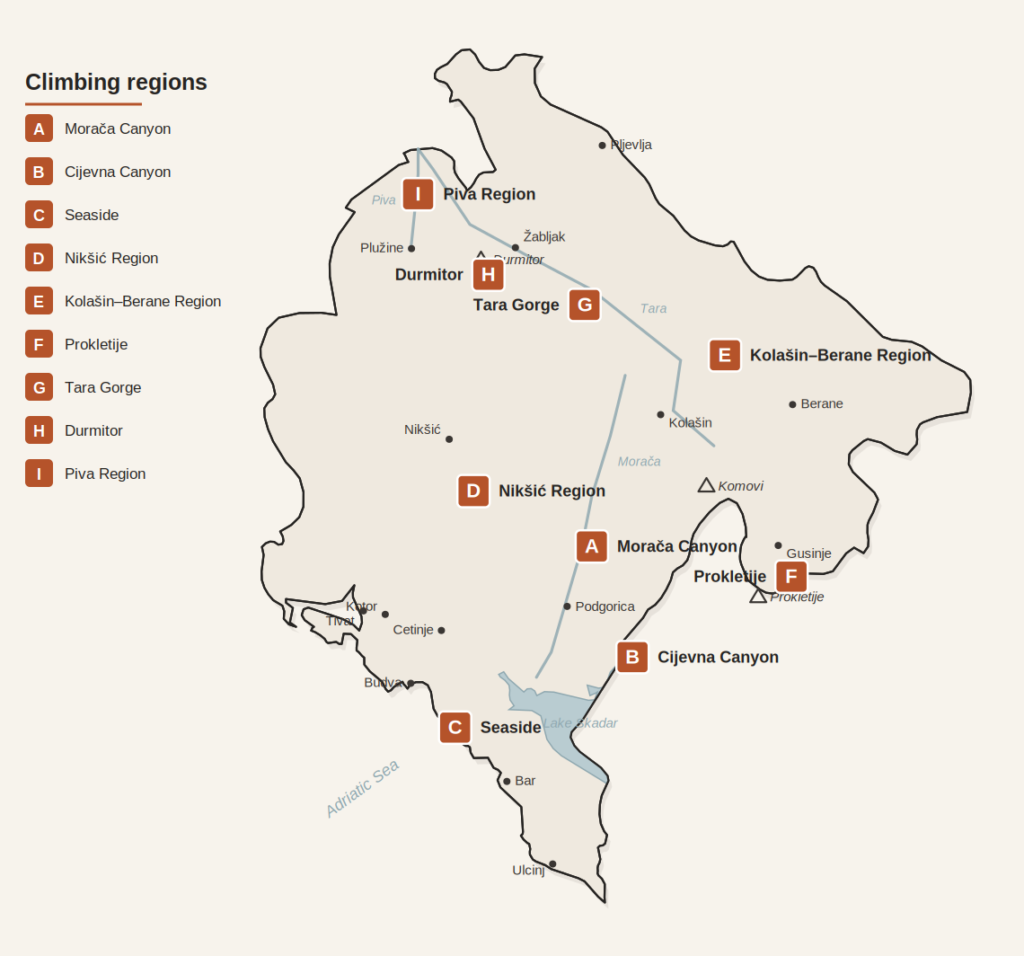
Montenegro offers sport climbing on quality limestone in a compact area: over 800 routes across 32 crags, spread over nine distinct regions — from crags close to the Adriatic to canyons, river gorges and high-mountain valleys. Approaches are often short, the crags are rarely busy, and thanks to the range of altitudes and landscape there is climbable rock in nearly every season and rock styles for nearly every taste.
800+ sport routes · 32 crags · 9 regions · limestone · climbing is possible most of the year
Each of the nine regions has its own character — different rock, different setting, different season. An overview:
A · Morača Canyon — An impressive 50 km gorge stretching all the way from Podgorica towards the mountains in the north. With Smokovac, this area features the biggest, best established and most well-known crag in the country. All in all you can so far find 6 sectors in the gorge, all centred around the little village of Smokovac. The sectors face either west or east, meaning you can find a shady spot all day long.
B · Cijevna Canyon — A picturesque river gorge stretching from Podgorica towards the Albanian border. Seven mostly sun-facing sectors, either next to the river or high up above the gorge just below the plateau, with a beautiful view. You can find a wide range of grades and styles. The potential for further development is still huge, with plenty of untouched walls all around.
C · Seaside — Mediterranean climbing above the coast, mostly centred around Kotor and Bar: everything from friendly waterdrop slabs to steep tufa lines, minutes from UNESCO old towns and chill beaches.
D · Nikšić Region — So far only a quiet single crag near the spectacular Ostrog monastery — modest in size, scenic in setting, and easily combined with a visit to one of the country’s most famous sights.
E · Kolašin–Berane Region — Between the small town of Kolašin — known mostly for skiing — and Berane to the east, you can find a handful of local crags with decent rock and cooler temperatures. Thanks to the newly built highway and the tunnel between Kolašin and Berane, these crags now have easy access and can be reached even as a day trip from Podgorica.
F · Prokletije — A wild national-park range on the Albanian border, home to some of the country’s highest and most impressive peaks. Sport routes have been developed around the small town of Gusinje. What this region is better known for, though, is its long tradition of alpine climbing, with some impressive routes opened up over the decades.
G · Tara Gorge — One of Montenegro’s most spectacular landscapes, known for rafting rather than climbing — so far. One shady, easy-access sector near Dobrilovina, and walls for much more.
H · Durmitor — Crags around Žabljak surrounding the Durmitor massif, at an altitude between 1,000–1,400 m — noticeably cooler than the rest of the country, and a good escape once the heat rolls in. The Durmitor massif itself adds a good selection of alpine multi-pitch climbs on excellent rock.
I · Piva Region — Two crags above Lake Piva near the small town of Plužine. Very different in landscape and environment from the rest of the country. Given the amount of rock faces you can see all around, there might be some further development in the future.
Still early:
Sport climbing is young here. The first routes were bolted in the early 2000s, the local community is small, and new lines are added every year — the development is far from finished.
When to come:
The best seasons for most crags are definitely spring and autumn with stable weather, dry rock and pleasent temperatures. Winter can be perfect as long as there is no rain. Summer is usually too hot except for the higher altitude crags.